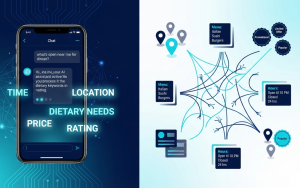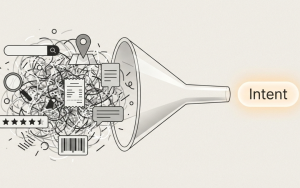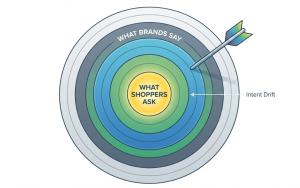
Enterprises have long treated the marketing technology stack as a collection of tools to manage campaigns, content, and analytics. That view is changing rapidly. The rise of AI discovery—where customers find answers through generative AI systems instead of traditional search engines—forces CMOs to rethink not just which tools they deploy, but the order of priority in building capabilities.
The new MarTech stack can be organized into 11 layers, from data foundations through compliance. Each layer plays a role, but the order of importance is shifting in the transition from web search to AI-driven answers.
| Layer/Category | Example Tools/Capabilities | Importance Rationale |
|---|---|---|
| Data & Infrastructure (CDP) | CDP, Data Warehouse, Identity Resolution, Tag Management | Foundation. GenAI consumes structured, high-quality, tagged data. CDPs, warehouses, and identity resolution ensure brands’ data is machine-readable and retrievable by AI. |
| AI Discovery & Execution (AIDX) | AEO, Taxonomy & Semantics normalization, AI Registry and Access | AEO requires new data source of truth framework for discovery and accurate answers. Existing data will need to be categorized and trained for product comparisons and insights performed by AI. Inaccuracies and hallucinations will hurt brand reputation and risk sales erosion. |
| Content & Experience (incl. DAM) | CMS, Personalization, A/B Testing, Digital Asset Management | GenAI answers require well-structured, context-rich content. CMS, personalization, DAM, and testing ensure content is discoverable, modular, and AI-friendly. |
| AI & Emerging Tools (AI Personalization) | Predictive Analytics, Generative AI, Conversational AI, AI-driven personalization | Directly tied to GenAI interface. Predictive AI, recommendation APIs, and conversational AI help brands integrate with agents and “answer browsers.” |
| Analytics & Insights | Web/App Analytics, Attribution Models, BI Dashboards | Critical to measure shifts from search clicks to GenAI referrals. Attribution must evolve to track AI agent–driven discovery and task execution. |
| Advertising & Acquisition (SEO/Ads) | DSPs, Ad Managers, SEO/SEM Tools | Paid links lose importance, but AI-native ad formats (sponsored answers, contextual targeting) require DSP/SEM evolution. |
| Commerce & Conversion | E-commerce Platforms, Product Recommendations, Reviews/Ratings | GenAI agents don’t stop at answering—they execute. Integration with commerce platforms and product recos enables “direct-to-task” conversion. |
| Campaign Mgmt & Automation / CRM | CRM systems, Marketing Automation, Email/SMS, Sales Automation | Still needed, but automation shifts from email/SMS blasts to AI-informed triggers and conversational campaigns. |
| Retention & Loyalty | Loyalty Mgmt, Surveys/Feedback, Referral Marketing | Becomes more valuable as customer acquisition via GenAI stabilizes. Loyalty data also feeds GenAI personalization, but less of a front-line requirement. |
| Social & Engagement | Social Media Mgmt, Community Platforms, Influencer Marketing | AI will still surface social content, but less central to the transition compared to structured owned data/content. |
| Governance & Compliance | Consent Mgmt, Privacy Compliance, Security | Always important, but ranked lower here. Privacy and consent frameworks are prerequisites, not direct levers in GenAI discoverability. |
Timeline and Resources
Transitioning to this new Martech stack is not instantaneous. CMOs should view it as a multi-year process:
- Year 1–2: Invest in foundational data and AIDX frameworks. Build taxonomies, normalize semantics, and implement CDPs with AI-ready pipelines.
- Year 2–3: Restructure content and experiences for modular, AI-readable delivery. Begin pilot projects with AI personalization engines.
- Year 3–5: Shift analytics, advertising, and commerce integrations to AI-native models. Expand retention and loyalty data into feedback loops.
The encouraging news: enterprises are not starting from scratch. Most existing investments—CRM, CMS, analytics, loyalty, social, and even traditional ad platforms—can be integrated into AI-driven discovery. With proper structuring, the Martech dollars already spent will accelerate the transition instead of being wasted.
The First Three Priorities for CMOs to Start in the Next 12 Months
1. Data & Infrastructure
Everything starts with data. AI systems can only produce accurate, brand-safe answers if the underlying customer and product data is structured, clean, and tagged. Customer Data Platforms (CDPs), data warehouses, and identity resolution engines form the foundation. Without this, downstream AI initiatives risk producing irrelevant or inaccurate results.
2. AI Discovery & Execution (AIDX)
This new layer represents the single most important adjustment for CMOs. AI discovery requires a source of truth framework that supports Answer Engine Optimization (AEO), taxonomy and semantic normalization, and access to AI registries. If data is not organized to feed AI models directly, brands risk hallucinations, mismatched comparisons, and lost sales. CMOs must invest in this layer now, building taxonomies that ensure AI systems recognize their products accurately.
3. Content & Experience
Once the data is structured and mapped for AI, the next priority is the content layer. AI does not just parse websites—it ingests structured content objects. CMS platforms, personalization engines, and digital asset management systems should be optimized so content is modular, tagged, and retrievable by AI agents.
The Supporting Layers Come Next… Expect New Vendor Entrants
Many of the supporting layers of the Martech stack—such as campaign automation, social engagement, retention, and governance—are likely to see an influx of new vendors as AI adoption accelerates. Legacy providers built on older architectures will struggle to retrofit their code for AI-native requirements like real-time semantic processing, predictive personalization, and agent-to-agent interoperability. This creates openings for startups and modern SaaS platforms that design from the ground up for AI-first use cases, offering lighter, more flexible systems that integrate natively with AIDX and other GenAI-driven layers. The result will be heightened competition, faster innovation cycles, and pressure on incumbents who cannot evolve beyond incremental add-ons.
- AI & Emerging Tools (predictive analytics, personalization engines, conversational AI) will accelerate once the top three layers are in place.
- Analytics & Insights must evolve to measure referrals and conversions driven by AI agents instead of search clicks.
- Advertising & Acquisition will shift toward AI-native ad formats and sponsored answers.
- Commerce & Conversion must connect seamlessly with AI agents that execute purchases or bookings directly.
- Campaign Mgmt & CRM will adapt from broad email pushes to AI-driven conversational triggers.
- Retention & Loyalty data will feed back into AI personalization and long-term engagement.
- Social & Engagement still matters but becomes secondary to structured owned content.
- Governance & Compliance underpins the stack to ensure privacy, consent, and regulatory confidence.
Looking Ahead
The marketing stack is no longer just a toolkit for campaign execution. It is a layered system that determines how AI discovers, interprets, and executes on behalf of your customers. CMOs who prioritize data infrastructure, AI discovery & execution, and content readiness will protect brand presence in the AI era and create a competitive edge in the years ahead.
CRSTBL’s AIDX
CRSTBL is pioneering AIDX (AI Discovery & Execution platform) called CRSTA-AI is a SaaS solution designed to work across all major GenAI platforms. AIDX ensures that brands’ products and services are accurately and consistently represented in AI-generated responses, protecting both visibility and reputation. Beyond discovery, AIDX establishes the framework for rapid predictive analysis and decisioning, enabling enterprises to create personalized, context-aware interactions with customers. By acting as the connective tissue between structured enterprise data and AI systems, CRSTBL’s AIDX empowers companies to future-proof their marketing stack and stay competitive in the AI-driven marketplace.