Marketing attribution has always been challenging. But as artificial intelligence reshapes how customers discover and evaluate products, we’re entering uncharted territory. When potential buyers ask ChatGPT, Claude, or Perplexity for recommendations instead of clicking through search results, the attribution models we’ve relied on for decades simply break down.
At CRSTBL, we’ve been studying this shift intensively. What we’ve found is both concerning and exciting: while LLMs create unprecedented attribution challenges, they also open doors to richer customer insights than ever before, if you know how to capture them.
The Growing Attribution Black Box
Traditional marketing attribution is already imperfect, but the rise of conversational AI is pushing us from “hard to track” to “fundamentally un-trackable” for a growing portion of the customer journey.
Here’s why AI-mediated discovery creates such profound measurement problems:
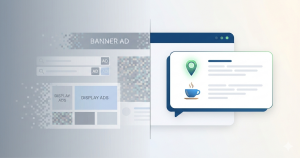
Zero-Click Conversions Are Invisible
When someone asks an LLM for product recommendations and gets your brand mentioned, there’s no site visit to track. No impression to count. No cookie to drop. The influence happens entirely within the AI conversation, leaving zero trace in your analytics.
The Recommendation Logic Is Opaque
With traditional SEO, you can monitor rankings, track click-through rates, and understand your visibility. But there’s no “GEO analytics dashboard” showing when or why ChatGPT recommends your product. You’re flying blind on a potentially massive influence channel.
Attribution Decay Accelerates
A customer might ask an AI for software recommendations on Monday, research your competitors on Tuesday, revisit your website on Wednesday, and convert through a direct visit on Friday. Traditional tracking tools—UTM parameters, referral data, cookies—only capture fragments of this journey. The AI touchpoint that initiated everything? Completely invisible.
Training Data Creates Phantom Attribution
Your attribution is affected not just by current marketing efforts, but by what content made it into LLM training data months or even years ago. A mention in your brand’s Wikipedia page or a well-linked blog post from 2023 might be driving recommendations today, but you’d never know it.
This phenomenon affects both GEO (Generative Engine Optimization) and AEO (AI Engine Optimization)—the emerging disciplines of optimizing content to appear in LLM responses. Companies investing in these strategies face a fundamental measurement problem: they’re optimizing for a channel they can’t see.
Current Solutions Are Still Validating
The industry recognizes this attribution gap, and various approaches are being tested. But the honest assessment is that all current solutions are incomplete:
Watermarking and Tracking Links
Some companies embed trackable elements in content that LLMs might reference. The problem? LLMs paraphrase and synthesize information rather than passing through links unchanged. Your carefully crafted tracking simply disappears in the AI’s reformulation.
Survey-Based Measurement
The most straightforward approach: just ask customers whether AI tools influenced their decision. This relies entirely on recall, though, and most customers won’t remember, or even realize, that an AI conversation three weeks ago planted the seed for today’s purchase.
Brand Lift Studies
Comparing purchase rates between people who use AI search tools versus those who don’t can show correlation. But establishing causation is murky, and these studies lack the granularity to guide tactical decisions.
Citation Tracking
Monitoring when your content appears in AI citations (like Perplexity’s source lists) provides some visibility. But many LLMs don’t cite sources consistently, and even when they do, you’re only seeing a fraction of the actual influence.
The verdict is still out on whether a single methodology will emerge as the standard or whether multiple approaches will be needed in combination. What’s clear is that the attribution problem is getting worse before it gets better, forcing many marketers to retreat to broader brand awareness metrics and incrementally testing, essentially accepting greater uncertainty.
CRSTBL Throws Hat In the Ring with AIDX, Attribution for the AI Era
At CRSTBL, we recognized that solving AI attribution requires working within the framework of how LLMs actually function. Not trying to retrofit old tracking methods onto a fundamentally different technology.
That’s why we built the CRSTA AIDX (AI-Discovery & Execution), a platform of foundational technologies designed specifically for the conversational AI landscape.
How AIDX Works
AIDX uses two core approaches to create visibility into previously invisible customer journeys:
Semantic Mapping Through LLM Interactions
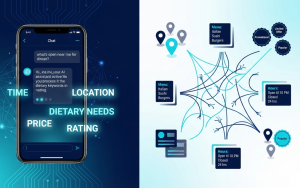
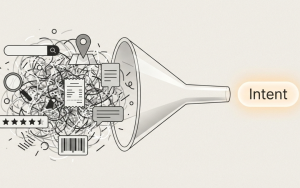
The content of conversations between users and LLMs reveals tremendous insight about consumer engagement and intent. AIDX analyzes these interactions. The questions asked, the information sought, the problems articulated to triangulate where a potential customer sits in your funnel.
By understanding the semantic patterns in how people discuss needs, evaluate options, and make decisions, AIDX can identify purchase intent and journey stage even without traditional tracking signals.
Historical Indexing for Predictive Accuracy
AIDX doesn’t just analyze individual conversations in isolation. It builds a historical index of conversation patterns across different customer lifecycle stages. This allows the system to predict fairly accurately where a potential customer is in their journey and what sources likely influenced them, even when those touch points aren’t directly trackable.
Beyond Attribution: Enabling Mass Personalization
Here’s where it gets even more interesting: the same technology that solves attribution also enables unprecedented personalization.
Because AIDX “remembers” conversations relative to aggregated patterns for customers at various journey stages, it creates a foundation for deeply personalized customer experience interactions. The system understands not just where customers are, but what information gaps they typically have at that stage and what questions they’re likely to need answered next.
This is mass personalization in the truest sense. Using AI conversation patterns to deliver individually relevant experiences at scale.
A Platform, Not Just a Tool
AIDX is designed as foundational technology, not a standalone application. Customized solutions can be built on top of it, tailored to each company’s specific funnel architecture and customer experience systems.
Without this foundational understanding of how LLM conversations map to your particular customer journey definitions, no standalone application can achieve the accuracy needed for effective attribution or the sophistication required for true mass personalization.
Looking (a little) Ahead
The attribution challenges created by conversational AI aren’t going away. They’re accelerating as AI becomes more deeply embedded in how people discover and evaluate products. Marketers who wait for “settled” solutions risk falling years behind in understanding and influencing their customer journeys.
The good news? While LLMs create attribution challenges, they also generate vastly richer signals about customer intent, needs, and decision-making processes than we’ve ever had access to before. The key is having the infrastructure to capture and interpret those signals.
At CRSTBL, we believe the future of attribution isn’t about tracking clicks, it’s about understanding conversations. And the companies that master that transition first will have an enormous advantage in the AI first era of marketing.
—
Interested in learning how AIDX can illuminate your customer journey in the age of AI? Contact CRSTBL to discuss how our attribution and personalization platform can transform your marketing measurement and customer experience capabilities.