If you’d rather hit play than scroll, the video version is HERE.
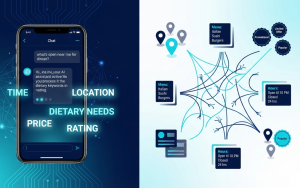
- “Do you have oat milk?”
- “Is this gluten-free?”
- “Are you open right now?”
- “Where can I buy this near me?”
- “Does this work with my diet or allergies?”
- “What’s the price, and is it in stock?”
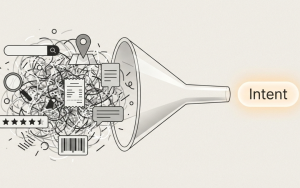
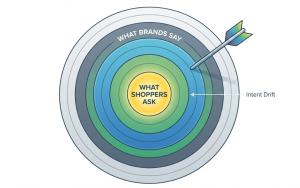
When your messaging does not answer the questions people are actually asking, you get intent drift. Your brand story and customer intent are moving in different directions. The result is not just a missed SEO opportunity. It’s lost conversion, wasted media spend, more friction for frontline staff, and a growing gap between what you say and what shoppers need.
What Intent Drift Really Is
- Your copy is heavy on identity and light on clarity.
- Your pages rank or get impressions, but people do not click because the snippet does not promise an answer.
- People click, then bounce, because the page does not help them finish the job.
This is not about “dumbing down” your brand. It’s about earning the next step by meeting intent quickly and confidently, then layering in story.
Why Intent Drift is Getting Worse
First, zero-click search is now normal. Multiple studies show that a majority of Google searches end without a click to any website. SparkToro’s 2024 study put zero-click at 58.5% in the U.S. and 59.7% in the EU.
Second, shopping discovery is fragmented. In February 2024, Jungle Scout data summarized by eMarketer found 56% of U.S. consumers start product searches on Amazon, while 42% start on search engines.
In a world where platforms answer directly, shoppers reward whoever provides the cleanest, most specific information fastest. Brand poetry is not enough.
The Business Cost of Intent Drift
- Higher paid media waste. You pay for clicks from high-intent queries, then send people to pages that do not match the promise.
- Lower conversion rates. Shoppers leave when they cannot confirm basics like price, availability, dietary fit, hours, or policies.
- More operational load. Stores and CX teams answer the same questions repeatedly because the answers are not easy to find.
- Weaker AI and search visibility. If your site and listings do not provide structured, consistent answers, platforms will fill the gaps with whatever they can find.
Bain has warned that “zero-click” behavior is reducing organic web traffic, estimating 15% to 25% declines tied to answer-first search experiences. That traffic loss is not evenly distributed. Brands with thin, vague, or inconsistent information feel it first.
Three Real-World Examples of Intent Drift
Example 1: Restaurants. “A chef-driven experience” vs. “Can I book this tonight?”
- “Seasonal, chef-driven menus.”
- “A modern take on coastal comfort.”
- “Do you take reservations?”
- “Is there a kids menu?”
- “Can you accommodate gluten-free?”
- “Is there parking?”
- “Happy hour times?”
- “Dress code?”
- “How loud is it?”
Example 2: C-stores. “Fresh food program” vs. “Is it open, and what’s actually there?”
- “Fresh, fast, and friendly.”
- “Made-to-order favorites.”
- “Is the kitchen open right now?”
- “Do you have hot food after 9pm?”
- “Diesel available?”
- “EV chargers?”
- “Clean restrooms?”
- “Lottery?”
- “Is there a car wash?”
Example 3: CPG. “Better for you” vs. “Does this fit my diet, and where do I buy it?”
- “Clean ingredients.”
- “Feel-good snacking.”
- “Is it keto?”
- “Sugar grams per serving?”
- “Contains peanuts?”
- “Is it vegan?”
- “What’s the serving size?”
- “Where can I buy near me?”
- “What’s the case pack for wholesale?”
How to Run an Intent Alignment Audit
Step 1: Pull intent signals from five places
- Google Search Console queries (what you show up for, even when they do not click)
- On-site search terms (what people type once they land)
- Paid search search terms (what is driving spend and whether landing pages match)
- Support and store questions (calls, chat logs, FAQs, even DMs)
- Reviews and “People also ask” patterns (recurring questions that reflect decision friction)
Step 2: Categorize intent, not keywords
- Know: “What is it?” “Ingredients?” “Calories?”
- Do: “How do I use it?” “How to order?” “How to redeem?”
- Go (local): “Near me,” “hours,” “parking,” “open now”
- Buy: “Price,” “in stock,” “delivery,” “case pack,” “minimum order”
Step 3: Score your current experience honestly
- Answer speed: Can someone get the key answer in 10 seconds?
- Specificity: Do you state the thing plainly, or imply it?
- Completeness: Are the top five decision questions answered?
- Freshness: Are hours, promos, inventory, and menus current?
- Consistency: Do your site, Google profile, and retailer listings agree?
Step 4: Fix the highest-leakage intent first
- Revenue impact (high-intent “buy” and “go” clusters first)
- Volume (queries that show up every day)
- Operational savings (questions that your team answers repeatedly)
- Ease (a quick FAQ module can outperform a full redesign)
What to Publish to Close the Gap
- Decision FAQs on PDPs, location pages, and menu pages
Focus on dietary fit, availability, policies, and “can I” questions. - Comparison and selection guides
“Which size is right?” “Which flavor is less sweet?” “Best for kids?” - Store and service truth tables for location pages
Hours, kitchen hours, services, payment types, amenities. - Attribute-first product modules
Serving size, allergens, certifications, claims, pack size, storage. - Schema and structured fields
Do not hide critical data in images or PDFs. Make it readable and consistent.
Measuring Success Without Getting Lost in Vanity Metrics
- Higher CTR on high-intent queries (because your snippet promises an answer)
- Lower bounce on key landing pages
- More “direction requests,” calls, reservations, and add-to-carts from local and product pages
- Fewer repeat questions to stores and CX
- More consistent brand answers across search and AI surfaces