For the past two decades, digital marketing has operated on a simple principle: interrupt the user journey with something relevant enough to redirect attention. Banner ads, sponsored search results, retargeting pixels—all designed to insert your brand into someone’s path before they’ve made a decision.
That model is about to become obsolete.
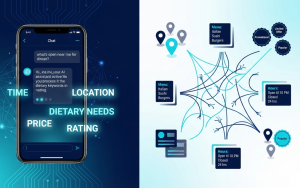
As AI assistants evolve from information retrieval tools into decision-making partners, the window for traditional advertising is closing. When a consumer asks an AI to “find me a healthy lunch option nearby,” they’re not browsing—they’re buying. The conversation itself is the bottom of the funnel. And in that context, an ad isn’t just ineffective. It’s a fundamental mismatch.
The Structural Problem with Ads in AI Environments
Traditional digital advertising relies on exposure and repetition. You pay for impressions, clicks, or conversions, but the underlying assumption is that most people who see your message aren’t ready to act. You’re building awareness, consideration, affinity—all the upper-funnel work that justifies the spend when only 2-3% convert.
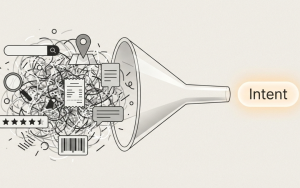
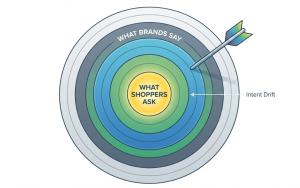
AI conversations don’t work that way. They collapse the funnel into a single exchange. The user expresses intent, and the AI responds with options that match that intent. There’s no browsing behavior to interrupt, no homepage to place a banner on, no search results page to dominate with paid listings.
More importantly, the AI’s value proposition depends on being useful, not promotional. If users start to perceive AI assistants as another advertising channel—where responses are influenced by who paid the most—the trust erodes. And without trust, the entire interface fails.
This isn’t a hypothetical concern. Google’s search experience has been degrading for years as paid listings have become harder to distinguish from organic results. Users have adapted by scrolling past ads or appending “reddit” to their queries to find unfiltered opinions. An AI assistant that prioritizes paid placements over genuine utility will face the same fate, only faster.
What Belongs Instead: Intent-Aligned Promotions
The solution isn’t to eliminate brand influence from AI interactions. It’s to fundamentally rethink when and how that influence appears.
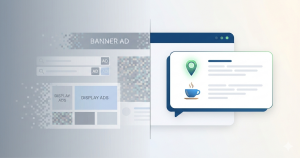
In an AI-driven environment, the only promotions that make sense are those that surface at the moment of expressed intent—and only when they genuinely match what the user is asking for. If someone says “I need coffee near Union Station,” that’s not the time for a display ad or brand awareness message. But it is the time for a local café to surface its current menu, pricing, or a limited-time offer on cold brew.
This is a shift from demand generation to demand capture. You’re not trying to create interest. You’re fulfilling interest that already exists.
The distinction matters because it changes everything about how marketers should allocate resources:
Awareness-driven advertising assumes you need to reach people before they know they want your product. You’re building mental availability so that when the need arises, your brand comes to mind.
Intent-aligned promotion assumes the need is already active. The user has raised their hand. Your job is to be present, accurate, and compelling at that exact moment—not three days earlier with a retargeting campaign.
Why This Shift Favors Execution Over Impression
For CMOs and brand leaders, this represents a fundamental reallocation of budget and attention. The traditional marketing stack—programmatic display, social ads, video pre-rolls—is built around reaching people in browsing mode. But AI conversations don’t happen in browsing mode. They happen in task-completion mode.
That means the competitive advantage shifts to brands that can:
- Maintain accurate, real-time availability across inventory, pricing, and hours
- Integrate seamlessly with the platforms where AI assistants pull data
- Optimize for local and contextual relevance, not broad demographic targeting
- Measure success based on conversion and fulfillment, not impressions or clicks
This isn’t just a technical shift. It’s a strategic one. Brands that have spent decades optimizing for awareness and consideration will need to rebuild capabilities around execution and delivery. That includes operational infrastructure—like inventory management and point-of-sale integration—that has historically lived outside the marketing org chart.
The Restaurant and C-Store Opportunity
Nowhere is this shift more immediate than in food service and convenience retail. These are high-frequency, high-intent categories. People don’t casually browse for lunch or gas. They have a need, and they want it solved quickly.
AI assistants are already being used to answer questions like:
- “What’s open near me right now?”
- “Which drive-thru has the shortest wait time?”
- “Where can I get a sandwich under $10?”
These queries represent active demand. The user is ready to transact. And the brands that win these moments won’t be the ones with the biggest ad budgets—they’ll be the ones with the most accurate, accessible, and actionable information.
For a regional fast-casual chain, that might mean ensuring that every location’s hours, menu, and current promotions are updated in real time across the platforms that feed AI responses. For a c-store operator, it could mean integrating fuel prices and in-store inventory so that an AI can answer “which station near me has the cheapest premium gas and hot coffee?”
This is demand capture at its purest. No brand building required. Just presence, accuracy, and relevance.
What This Means for Marketing Strategy in 2025 and Beyond
The transition from ad-supported to intent-aligned promotion won’t happen overnight. Google, Meta, and other platforms have built empires on the current model, and they’ll defend it as long as possible. But the trajectory is clear.
As AI assistants become the default interface for an increasing share of consumer decisions—from dining and shopping to travel and healthcare—brands will need to rethink where and how they show up. The winners will be those who recognize that the conversation itself is the destination, not a stepping stone to somewhere else.
Here’s what that looks like in practice:
Shift budget from awareness to availability. If your AI strategy still centers on “getting the brand in front of people,” you’re solving the wrong problem. Focus instead on being present when intent is expressed.
Invest in operational data infrastructure. Marketing increasingly depends on real-time data about inventory, pricing, hours, and capacity. If your systems can’t support that, your brand won’t surface when it matters.
Measure performance at the point of decision. Impressions and reach are metrics from the browsing era. In AI environments, the only number that matters is conversion at the moment of expressed need.
The Bottom Line
Ads, as we’ve known them for the past 25 years, are designed for a world where marketing interrupts attention and redirects it toward a brand. But AI conversations don’t work that way. They resolve intent, they don’t create it.
For CMOs and brand leaders, this is both a challenge and an opportunity. The challenge is letting go of strategies built around exposure and repetition. The opportunity is aligning with how consumers actually want to interact with brands—not as an interruption, but as a solution delivered at exactly the right moment.