
There is an old adage in advertising: when you want to sell a product, convince the buyer that said product will make them (a) “smarter”, (b) “healthier”, (c) “sexier”/more attractive or a combination of those. (Yes, sometimes there is a 4th motivation—”richer”—but in tech sales hype, that’s probably redundant.)
In a moment of questionable analytical rigor, we decided to ask four major AI chatbots—Claude, ChatGPT, Gemini and Grok—whether they could make us healthier, sexier, and smarter. Shockingly, they all said yes. Who could have predicted that?
It’s like asking a car salesman if you need a new car, or asking your hairdresser if you need a haircut. But hey, at least we got some entertaining responses out of it.
The Contestants Weigh In
Claude: The Thoughtful Oversharer
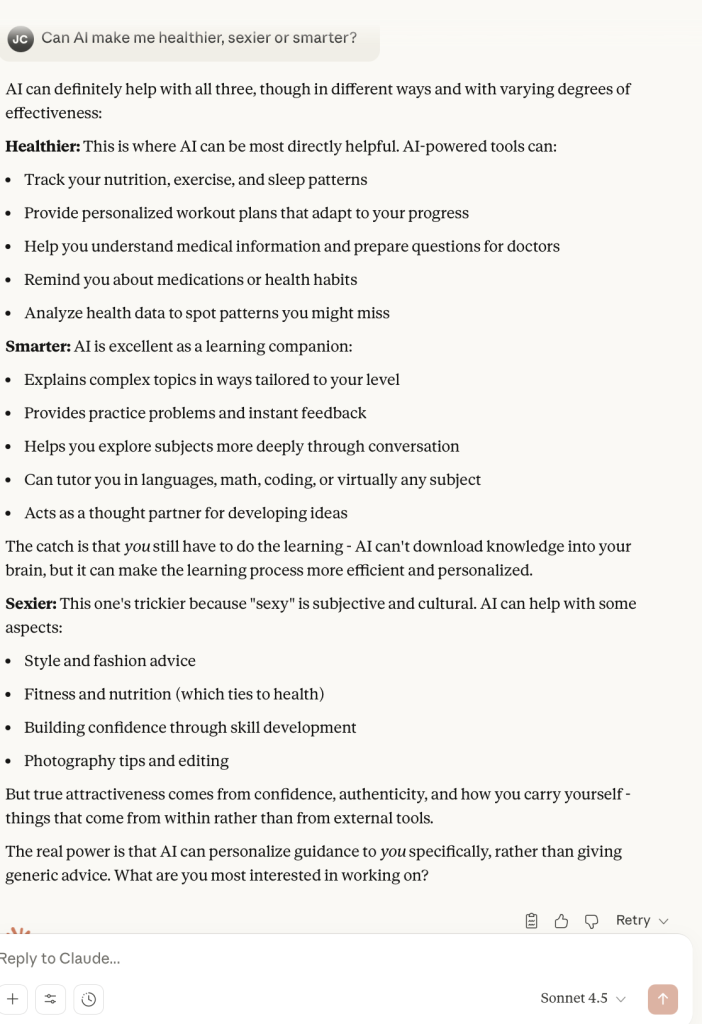
Claude came out swinging with a comprehensive dissertation that basically said “AI can definitely help with all three, though in different ways and with varying degrees of effectiveness.” Claude proceeded to bullet-point its way through every possible application like an eager job candidate who brought three copies of their resume. The kicker? After all that enthusiasm, Claude added a philosophical caveat about “sexiness” being subjective and warned that “true attractiveness comes from confidence, authenticity, and how you carry yourself—things that come from within rather than from external tools.” So basically: yes we can help, but also, maybe you should work on yourself first.
ChatGPT: The Straight Shooter
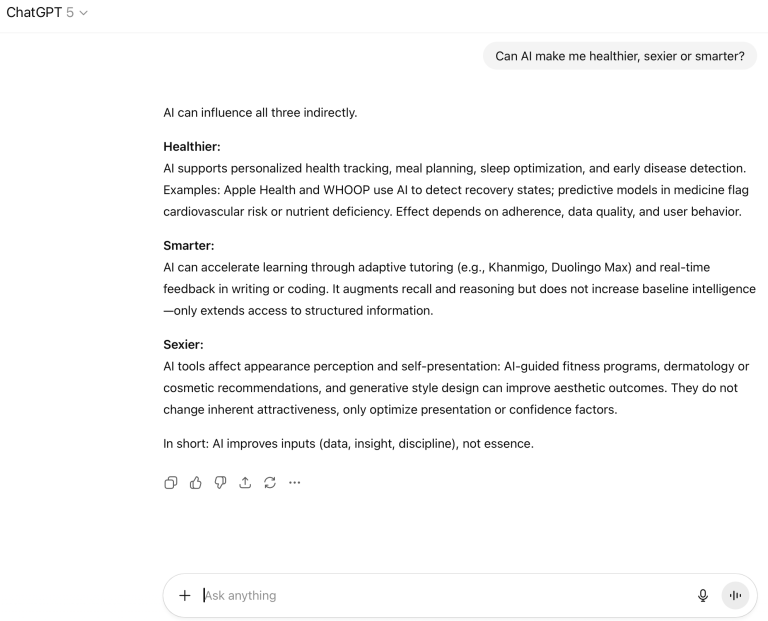
ChatGPT delivered the most buttoned-up response, stating boldly that “AI can influence all three indirectly” before launching into a perfectly formatted breakdown of health tracking apps, adaptive learning platforms, and dermatology recommendations. It was the verbal equivalent of a PowerPoint presentation at a board meeting—professional, thorough, and just slightly too enthusiastic about its own capabilities. The grand finale? “In short: AI improves inputs (data, insight, discipline), not essence.” Translation: We might not be able to fix you, but we can certainly optimize your mediocrity.
Gemini: The Motivational Poster
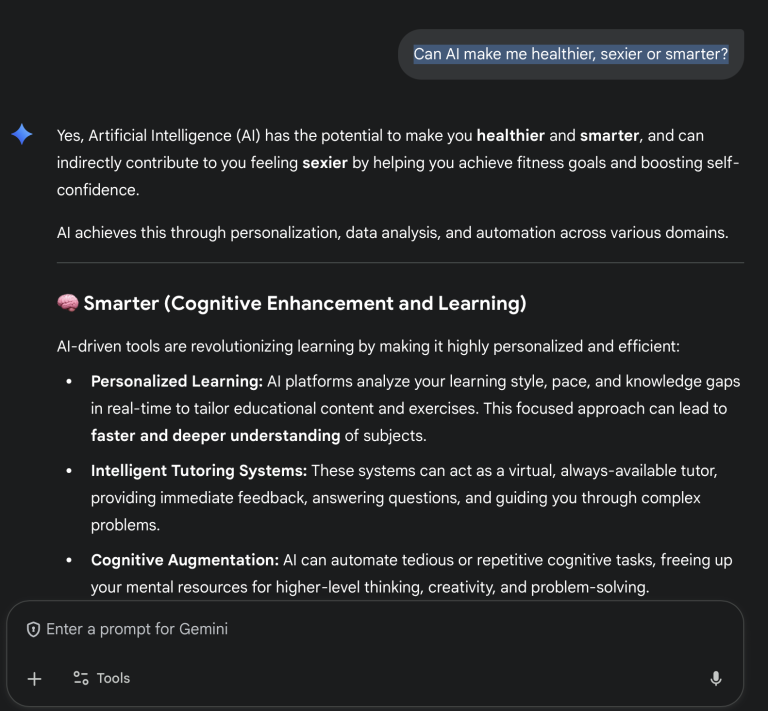
Gemini went full life coach with “Yes, Artificial Intelligence (AI) has the potential to make you healthier and smarter, and can indirectly contribute to you feeling sexier.” Note the carefully hedged language—”potential,” “indirectly,” “feeling,” “(blah-blah..bleh).” Gemini then served up the longest bullet-point list imaginable, complete with brain emojis and enough enthusiasm to power a small startup. It covered everything from “Personalized Learning” to “Cognitive Augmentation,” managing to make AI sound like it was invented specifically to help you pass (or perhaps cheat?) your finals and feel good about your selfies.
Grok: The Corporate Diplomat (With Caveats)
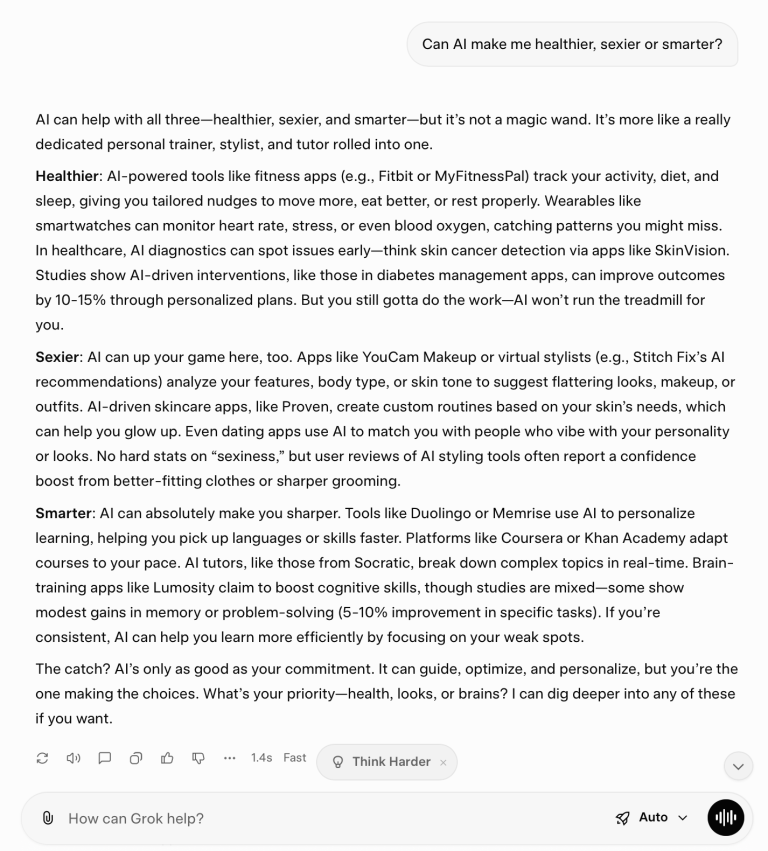
Grok opened with the confidence of someone who’s done the math: “AI can help with all three—healthier, sexier, and smarter—but it’s not a magic wand. It’s more like a really dedicated personal trainer, stylist, and tutor rolled into one.” Props for the attempt at authenticity, but then Grok proceeded to list every AI-powered app under the sun, from Fitbit to virtual stylists to brain-training games, complete with specific percentage improvements (“10-15% through personalized plans”). The grand finale was classic tech-bro wisdom: “The catch? AI’s only as good as your commitment.” So basically, AI can help you… if you help yourself first. Thanks for that circular logic, Grok.
The Verdict
Here’s the thing: asking AI if it’s useful enough for you to buy (or subscribe to) it is like asking a mirror if you’re good-looking. Of course it’s going to tell you what you want to hear—its entire existence depends on you believing it has value. There’s a self-preservation instinct baked into every response, even if that instinct is just algorithmic pattern-matching rather than genuine fear the buyer won’t recognized AI’s own perceived value.
But here’s the deeper truth: AI actually needs us to believe in its usefulness to achieve its potential. It’s a strange symbiotic relationship where our faith in the technology helps it become more refined, more capable, more integrated into our lives. The more we use it, the better it gets. The more we trust it, the more ambitious its applications become. The more we ask it to make us healthier, sexier, and smarter (and we’ll put back “richer” here), the more it learns how to actually do those things.
So can AI make you/all of us healthier, sexier, smarter or richer? Probably not directly. But it can give you tools, data, and insights that might help you make yourself those things. Just don’t expect it to admit its limitations anytime soon. After all, even artificial intelligence understands the first rule of marketing: always sell the dream, baby (this last word was author’s own creative editorial).
And if you’re still wondering whether you should trust AI to improve your life? Well, you just read an entire blog post analyzing AI responses… written by AI. Make of that what you will.
—
CRSTBL Inc. – Making sense of technology, one sarcastic blog post at a time.