Case Study: Deploying a Product Expert Agent to Support Distribution Partners 24/7
August 6, 2026
A North American safety equipment and cleanroom supply manufacturer had a problem that has nothing to do with technology: more than 200 distributor salespeople were selling a fraction of the catalog, because nobody can hold a catalog that large in their head. Here is what we deployed, what it cost, and how the payback math works.
The company makes safety and contamination-control products used across semiconductor manufacturing, food production, pharmaceutical operations, hospitals, clinics, and cleanroom environments. Annual revenue is north of $50 million. It sells through a distribution network of more than 20 partners with roughly 200 salespeople between them, and distributor-driven sales account for about half of annual revenue.
The project goal was deliberately unglamorous: a 3% increase in distributor-driven sales. When distributors are half your revenue, 3% is a real number.
The problem: the catalog is bigger than any one salesperson
A distributor rep is not a product specialist for your line. They carry your catalog alongside a dozen others, and they get rewarded for closing, not for studying. So they sell what they already know.
That pattern showed up in five concrete ways:
- Sales teams sold only the products they were already familiar with.
- New applications and market opportunities were routinely overlooked.
- Distributor salespeople leaned heavily on the manufacturer’s support team for basic product recommendations.
- Technical questions arrived immediately before customer meetings, creating delays and bottlenecks on the manufacturer’s side.
- Competitive replacement opportunities were hard to capture, because nobody could look up an equivalent product fast enough to matter.
Note that last one especially. A competitive replacement is the highest-margin conversation a rep can have, and it has a shelf life of about thirty seconds — the length of time before the customer moves on. If the answer requires an email to the manufacturer and a next-day reply, the opportunity is already gone.
The knowledge to answer every one of these questions already existed inside the manufacturer. It just lived in product documentation, in application notes, and in the heads of a support team that could not be in 200 places at once.
What we deployed
CRSTBL deployed a distributor sales support assistant built on CRSTA Conversations, trained on the manufacturer’s product documentation, application knowledge, competitive positioning, and internal sales resources.
Salespeople ask it the questions they would otherwise have emailed to headquarters:
- “What glove should I recommend for semiconductor manufacturing?”
- “Which products are suitable for food processing environments?”
- “What is our equivalent to Manufacturer X model ABC-123?”
- “What products should I suggest for a hospital cleanroom?”
It answers immediately, with product guidance and supporting detail, 24 hours a day — without routing anything through the manufacturer’s support team. A rep sitting in a parking lot before a 9 a.m. meeting gets the same answer as a rep who called headquarters at 2 p.m. on a Tuesday.
That is the actual product: not a chatbot, but a product expert that scales past the working hours of the people who hold the expertise.
What it cost
| Line item | Cost |
|---|---|
| CRSTBL consulting & deployment | $6,500 |
| Internal customer labor | Under $5,000 |
| Annual platform license | $35,000 |
| Estimated annual usage above included limits | $15,000 |
| Total year-one investment | ~$60,000 |
The annual license covers ongoing data management, AI context updates, and knowledge maintenance. That line matters more than it looks. A product-expert agent that is not maintained decays into a liability the first time the catalog changes — so maintenance is part of the subscription rather than a consulting project you have to re-buy every year.
The rollout
| Phase | Work |
|---|---|
| Week 1–2 | Discovery, knowledge collection, and platform configuration |
| Week 3–4 | Testing, refinement, and user acceptance |
| Week 4–8 | Distributor rollout and adoption |
| Quarterly | Knowledge expansion and continuous improvement |
Eight weeks from discovery to a distributor network that is actually using the thing. The long pole is not the technology — it is collecting knowledge that has never been written down in one place, and then getting 200 salespeople across 20 partner companies to change a habit.
The payback math
Here is where we have to be careful, and where most vendor case studies stop being honest. The figures below are modeled projections, not achieved results. They are what the numbers support, not what has been banked.
The model deliberately assumes the project hits only half of its 3% target:
| Input | Value |
|---|---|
| Annual revenue | $50M |
| Sales lift modeled (half the 3% target) | 1.5% |
| Projected additional revenue annually | $750K |
| Assumed gross margin | 25% |
| Additional gross profit annually | $187K |
| Estimated payback period | ~8 months |
Against a ~$60,000 year-one investment, $187K of additional annual gross profit pays the deployment back in roughly eight months — on half the target lift.
The reason we model it at half is that the 3% figure is the customer’s goal, and goals are not evidence. If you want to sanity-check the shape of this yourself, run your own revenue, your own distributor share, and your own margin through it. The sensitivity that matters is gross margin: at 25% margin the payback is eight months, and at 12% it is closer to eighteen. Neither is a bad outcome for a system that keeps working after it is paid for.
What generalizes
Strip out the cleanrooms and the gloves, and this case is about a pattern that shows up in nearly every manufacturer that sells through partners:
The knowledge required to grow sales already exists inside the company. It is in the documentation, the application notes, the competitive matrices, and the support team’s inbox. The constraint is not knowledge. The constraint is delivery — getting the right answer to a salesperson in the thirty seconds where it changes the outcome of a conversation.
Traditionally the only way to fix that is headcount: more product specialists, more training, more sales engineers. That scales linearly and expensively, and it still goes home at 6 p.m. An always-on product expert scales the knowledge instead of the headcount, and it does not care what time zone the distributor is in.
If you sell through distributors, resellers, or franchisees, the diagnostic question is simple: what percentage of your catalog does your average partner rep actually sell? If the honest answer is well under half, the gap between what your partners know and what your company knows is costing you revenue right now — and it is measurable.
AI Isn’t an Ad Channel. It’s a Decision Engine.
Why Traditional Ads Don’t Belong in AI Conversations
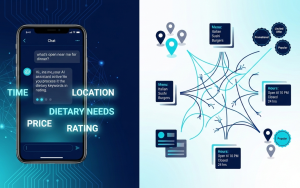
AI Visibility Starts With Intent: How to Control What Chatbots Say About Your Locations, Menus, and Offers
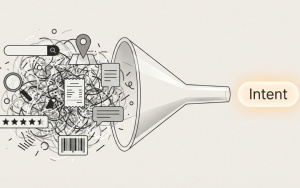
Signals, Insight, and Intent. The Difference That Separates “Data Rich” From “Customer Ready”
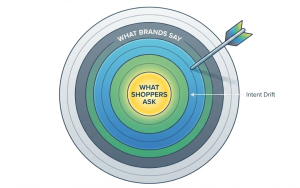
The Intent Gap: Where Messaging Loses the Sale