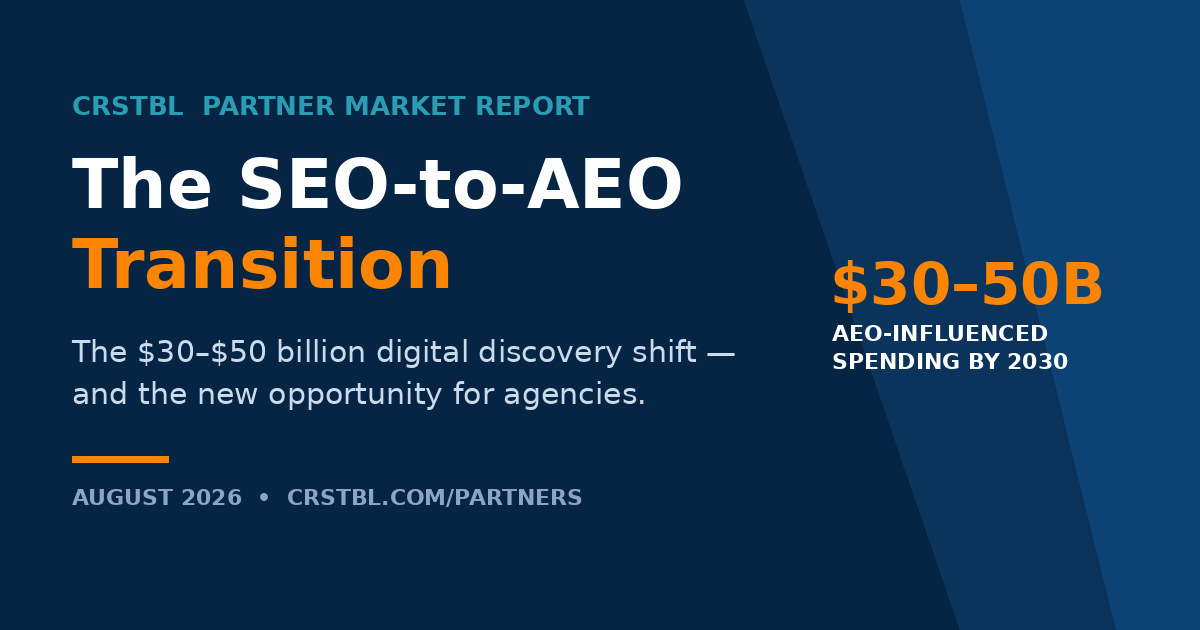
The SEO-to-AEO Transition: The $30-$50 Billion Digital Discovery Shift
August 10, 2026
Search is becoming an answer layer. We published a partner market report on what that shift is worth, what the evidence actually supports, and where the agency opportunity sits. This is the short version — the full 15-page report is available below as a free download, no form.
Download the full report (PDF) →
The headline number, and what it is not
We estimate that $8–$15 billion of global annual spending is already influenced by Answer Engine Optimization, with a plausible $30–$50 billion annual market by 2030.
That number needs an immediate qualifier, because most market sizing in this category does not come with one. A significant portion of that spending is reallocated from existing SEO and content budgets, not net-new. Agencies should read it as the total addressable budget pool, not incremental revenue waiting to be claimed. It is also a modeled range, not a forecast — the actual figure could fall outside it. Methodology is in the report.
What the estimate covers: AEO measurement software, content and optimization services, structured business information, publishing infrastructure, and implementation. What it does not claim: that SEO is dead. SEO budgets are large and growing. AEO is expanding the discovery stack, not replacing it.
The interface is moving closer to the decision
Digital discovery has moved through links (1998), mobile (2007), local (2012), chat (2022), and AI Overviews (2024). The 2026 milestone is agents — AI systems that do not simply answer a question but take action: booking a table, comparing prices, placing an order.
Traditional SEO optimized a business for ranked links. AEO must also prepare the business for synthesized answers, comparisons, recommendations, and increasingly agentic actions. The website still matters. It is simply no longer guaranteed to be the first place a customer encounters your narrative.
The scale signal: Google reported 2.5 billion monthly users for AI Overviews by mid-2026, up from 1.5 billion in May 2025 — a billion users added in thirteen months — plus more than a billion monthly users for AI Mode. This is being embedded inside mainstream search, not confined to standalone chat products.
Three structural risks clients are carrying right now
1. Loss of narrative control
Answer engines assemble responses from multiple sources. A business supplies one of them. Platforms, directories, publishers, and reviews influence the rest. Inaccurate or outdated information becomes difficult to trace and correct, and every interpretation layer between the business and the customer reduces control.
Pew Research observed the downstream effect on traffic: traditional-result clicks occurred in 8% of visits with an AI summary versus 15% without, and only 1% of users clicked a source inside the summary. Two caveats we insist on — that data reflects March 2025 browsing behavior, before Google merged AI Overviews with AI Mode and added Preferred Sources labels. Treat the direction as reliable and the specific percentages as a baseline, not a current snapshot.
2. Premature technology commitments
AEO platforms, model behavior, protocols, attribution methods, and publishing standards are all evolving at once. A complex implementation today can create expensive switching costs before the market produces stable winners.
The practical response is not inaction. It is sequencing: establish authoritative business information, publish it in adaptable formats, deploy one measurable customer-facing use case, and add integrations only after utility is demonstrated. The agency principle we would put on a wall — minimize irreversible architecture. Favor systems that launch quickly, export their data, work alongside the existing website, and keep producing value even if a particular answer engine or protocol changes.
3. Expertise has to be validated by utility
Even experienced marketers cannot reliably predict which AEO tactics, vendors, or standards will still matter in eighteen months. Recommendations should be treated as testable operating hypotheses, not permanent architecture decisions.
The report lays out an evidence ladder for this: claim → pilot → utility → evidence → scale. Investment expands only after utility is demonstrated. A strong agency earns trust by narrowing uncertainty — define the client problem, run a contained deployment, measure whether it helps, expand when the evidence supports it.
The demand signal is real, even where the standards are not
| Signal | Figure |
|---|---|
| Semrush AI-product ARR, Dec 2024 → Dec 2025 | $4M → $38M (9.5×) |
| Enterprise leaders planning to increase AEO investment | 94% |
| Reporting positive funnel impact | 97% |
| Already using an integrated AEO platform | 51% |
Read those enterprise figures with care. The Conductor survey drew from enterprise digital leaders, many of them existing Conductor customers, and 73% classified their own AEO programs as advanced or very advanced. The numbers establish that committed early adopters are doubling down — a meaningful signal — but they are not a census of the broader market. Semrush’s 9.5× growth is likewise real and off a small base, inside a $471 million ARR business.
Vendor-reported figures are directional. Definitions differ, products bundle SEO and AEO capabilities, and services spending is frequently counted separately. Agencies that can hold that line with clients — honest about what is known and what is not — will build more trust and longer retainers than those selling certainty in an uncertain market.
The agency opportunity is advisory, not tool resale
The pathway we recommend is phased and reversible: audit → structure → deploy → measure → expand. Find the gaps, create authoritative context, start conversations, capture intent, then connect selectively.
That maps to five service lines an agency can bill against: business-information audits, context preparation, AI representation monitoring, conversation deployment, and ongoing optimization. Clients need help deciding what information should become authoritative, how it should be published, which AI surfaces matter, and when an investment has demonstrated enough utility to scale. None of that is a software resale motion.
CRSTBL supplies the operational layer underneath it. Partners package Conversation Agents (CRSTA) and AI Discovery (Cumae) for clients while keeping the advisory relationship. Client menus, products, services, locations, and sales knowledge become structured context that powers conversations today and improves discovery readiness tomorrow — through low/no-code deployment and selective open-standard connectivity including MCP, rather than a speculative deep stack.
A practical first engagement
Select one client with meaningful website traffic or a complex product, service, or location portfolio. Audit how its information appears across the website and AI surfaces. Deploy one controlled conversational role. Use the actual customer questions that come back to identify the next context and content priorities.
Our 90-day partner ramp-up is built for exactly that: start with one client, no CRSTBL platform fees for 90 days, and our team builds every agent alongside yours. At day 90 you have a measured cost-per-conversation report, real visitor intent data, and up to five reference deployments. Your consulting and project fees remain yours.
The full report includes the complete methodology, source notes, a boundaries section on what the evidence does not support, and the details of the Agency Partner Advisory Board launching in Q4 2026.
Download the full report (PDF) → Explore the Agency Partner Program →
Sources: Google/Alphabet earnings calls and I/O keynote (AI Overviews reach); Pew Research Center, July 22, 2025 (click behavior, data collected March 2025); Conductor, “The State of AEO/GEO in 2026: CMO Investment Report”; Semrush FY2025 results, March 2, 2026; Mordor Intelligence and MarkNtel Advisors (SEO services market base). Market estimates and scenarios are inherently uncertain and should not be read as guarantees of outcome.
AI Isn’t an Ad Channel. It’s a Decision Engine.
Why Traditional Ads Don’t Belong in AI Conversations
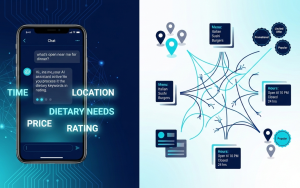
AI Visibility Starts With Intent: How to Control What Chatbots Say About Your Locations, Menus, and Offers
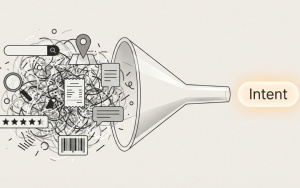
Signals, Insight, and Intent. The Difference That Separates “Data Rich” From “Customer Ready”
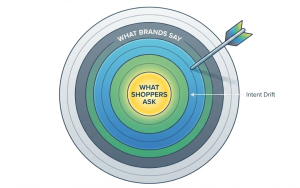
The Intent Gap: Where Messaging Loses the Sale