By John Chang, CEO & Co-founder, CRSTBL
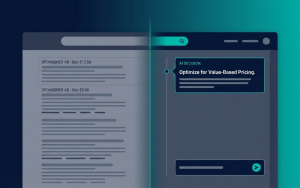
For a decade, getting found online meant one thing: ranking in search results. You optimized keywords, built backlinks, and hoped to climb the Google results page. That playbook is no longer the whole game.
Today, your customers are asking ChatGPT where to eat, asking Gemini which HVAC company to call, asking Perplexity to compare local services. These AI systems don’t return a list of links, and often they don’t even go to your website. They return answers to the requestor. And if your business isn’t part of that LLM’s reference locations for constructing that answer, your company is invisible to a fast growing share of your market.
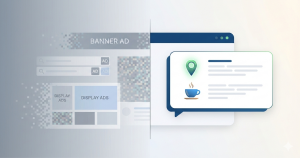
This is the shift from SEO (Search Engine Optimization) to AEO (AI Engine Optimization). And like any major platform and user behavior shift, it requires rebuilding the technology infrastructure — not just new tactics with the same tech stack.
After mapping the competitive landscape across 20+ vendors in conversational AI and AI discovery, we’ve identified the functional layers that make up the emerging AEO tech stack. Some didn’t exist a year ago. All of them matter if you want your business to be accurately represented in AI-generated answers. We added our own services to the table so customers can see what we set out to accomplish relative to the technology that we think business customers will need.
| Priority | Layer | What It Does | Who Provides It |
|---|---|---|---|
| 1 | AI-Readable Business Foundation | Structures your business data — menus, services, hours, pricing — so AI systems can represent you accurately | CRSTA, Yext, schema markup tools |
| 2 | Conversational Discovery | AI on your website that helps visitors explore and decide through natural conversation, not just keyword search | CRSTA, Fin (Intercom), Tidio, Ada |
| 3 | AEO Visibility Monitoring | Tracks how AI assistants mention, cite, and describe your brand across ChatGPT, Gemini, Perplexity, and others | Cumae, Scrunch, Profound, Otterly, Peec |
| 4 | First-Party Intent Intelligence | Captures what your actual visitors ask about your business — the questions, preferences, and gaps only you can see | CRSTA + Cumae |
| 5 | Content Optimization for AI | Audits and rewrites content so AI systems cite you accurately and frequently | Scrunch AXP, Profound, Adobe LLM Optimizer, HubSpot AEO |
| 6 | Market-Level AI Demand Intelligence | Reveals what people ask AI about your category and competitors at population scale | Cumae, Aiso, Profound, Semrush AI Visibility |
| 7 | Voice & Multimodal AI | Extends your AI presence to phone, voice assistants, and avatar interfaces | CRSTA, Retell, ElevenLabs, Bland, Tavus |
| 8 | SEO Foundation | Maintains the organic search base that still drives traffic — and feeds AI training data | Semrush, Ahrefs, Moz, Conductor, BrightLocal |
We included a column for priority ranking (our opinion regarding what technology and processes in the stack to invest in first) that reflects a dependency chain — each layer builds on the one before it.
Layer 1 comes first because AI response accuracy degrades badly without it. If your business data isn’t structured and accurate, every AI system that tries to represent you will get it wrong. Wrong hours, wrong menu, wrong services and perhaps even wrong industry. You can’t optimize what isn’t organized. This is both a technology as well as a business process challenge.
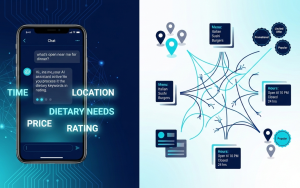
Layer 2 is where conversion happens. Once your data is structured, you need a way for visitors (as well as AI chatbots and agents) to actually interact with it. A static FAQ page doesn’t cut it when your competitor’s website has a conversational AI that can answer “Do you have a private dining room for 8 people for a special birthday dinner?” in real time.
Layer 3 is your early warning system. You need to know how AI systems are talking about you before you can improve it. Are they recommending your competitor instead? Citing outdated information? Getting your pricing wrong? If you’re not monitoring, you’re flying blind and your business reputation may suffer because of it.
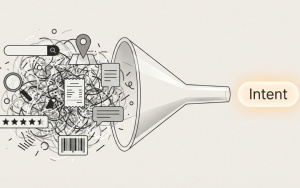
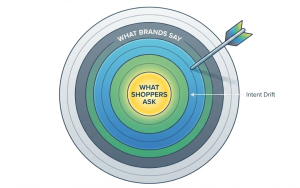
Layer 4 is where differentiation between vendors exposes each vendor’s technology roadmap philosophy. This is the layer most companies fail to look far enough into the future — and it’s the most valuable. Market-level intelligence (Layer 6) tells you what people ask about your category in general. First-party intent intelligence tells you what your visitors ask about your business specifically. That’s a fundamentally different dataset, and it only exists if you own the conversation layer. This is a conversion process that takes months and years, not days and weeks. If you don’t start now, you’ll be behind.
Layers 5 through 8 are amplifiers. They leverage the foundation layers to make them go farther — better content, broader reach, deeper market understanding, and the SEO base that continues to matter.
When we mapped these layers against the vendor landscape, one pattern stood out: most companies operate in only one or two layers. This may be due to how early in the SEO-to-AEO transition process we are still living in.
Visibility monitoring tools don’t handle conversations. Conversational AI platforms don’t track how AI systems represent your brand. SEO tools are adding AEO features, but they’re built for marketing teams, not for the business and the numerous AI agents that will likely visit its website in the future.
The thinking gap is at the intersection of Layers 1, 2, and 4 — where the business data, the customer conversation, and the intent intelligence overlap in a Venn diagram. That’s the chasm we built CRSTBL to occupy: CRSTA for the experience layer (what your visitors see and interact with) and Cumae for the intelligence layer (what AI systems know and say about you).
But regardless of what tools you choose, the framework holds. If you’re a business thinking about the SEO-to-AEO transition, these are the eight capabilities you need to evaluate — and the order you should build them in. Also, keep in mind that de-risking your decision starts with a clear vision of the roadmap that fits your needs. Every company will have their own roadmap — but everyone should avoid making big technology investments at the start. Things are moving around too quickly to make a long-term bet. There is just too much risk.
If you’re running a restaurant, a local service business, or any company that depends on being discovered by customers in your area, here’s the practical starting point:
This week: Audit your structured data. Can an AI system read your hours, services, and pricing without scraping and guessing? If you don’t have structured markup, you’re already behind.
This month: Check how AI systems represent you. Ask ChatGPT, Gemini, and Perplexity about your business by name. What they say back is what your potential customers are hearing.
This quarter: Evaluate conversational AI for your website. The businesses that let visitors ask questions and get real answers — instead of hunting through pages — will capture the customers that AI sends their way.
The SEO-to-AEO transition isn’t coming next year. It’s here waiting for you to start organizing your data and tech stack.
CRSTA manages the conversations you have with customers directly. Cumae controls how external AI systems describe your business. Together, they help local businesses and enterprises manage both their own AI conversations and their representation across AI platforms. Learn more at crstbl.com.